🇺🇸
Open app

24 hours in a day — how do you show that?

Your child reads the clock just fine. But how do you teach them that a day is 24 hours? Start by making the AM/PM conversion adults do in their heads visible to the child.

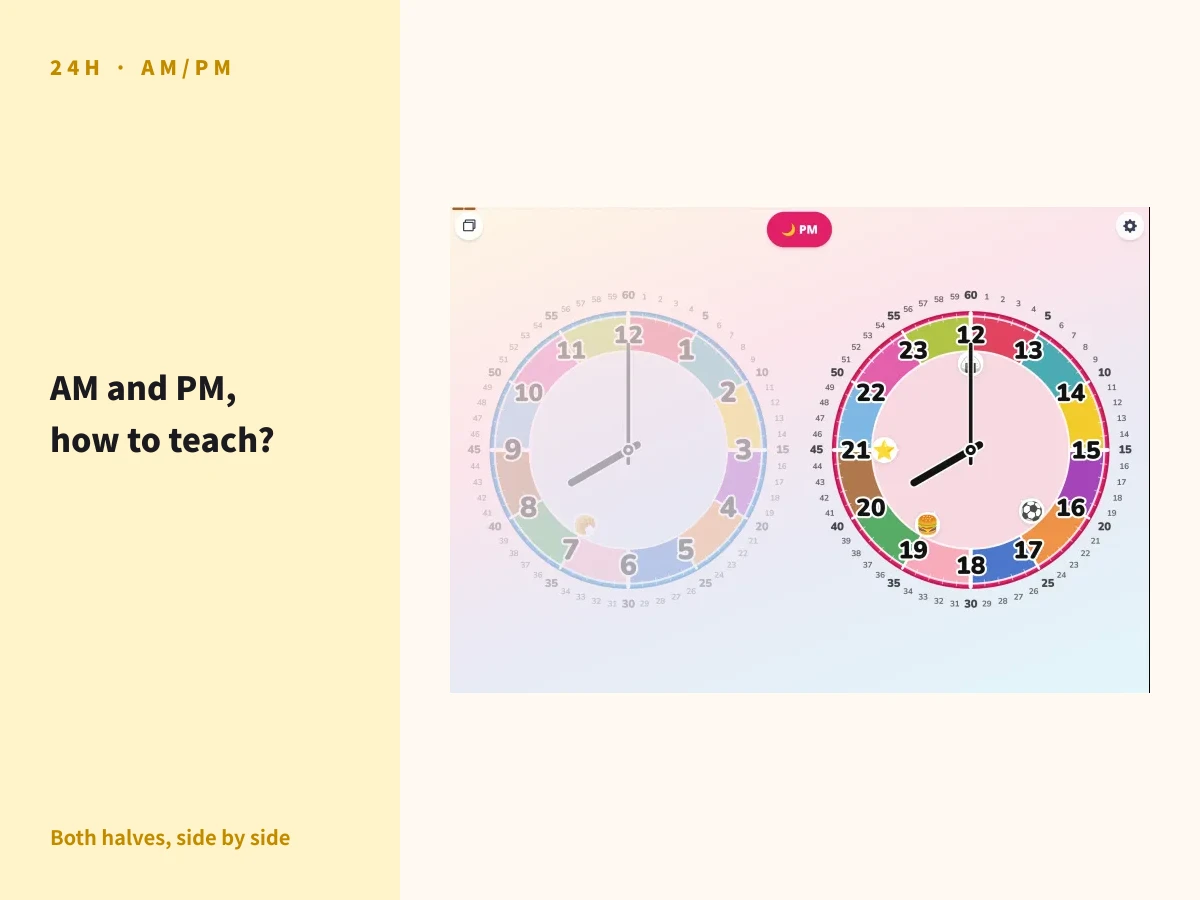
Futatoki the Learning Clock App showing AM and PM faces side by side — two analog clocks laid out next to each other so a child can see the morning/evening conversion, a free browser-based clock app for kids.

Your child can already read an analog clock. But the moment it comes to "a day has 24 hours," many grown-ups suddenly don't know where to start. You're not the first to pause right at this spot. Adults translate AM and PM every time they read a clock: morning or evening, 8 or 20. That conversion is invisible to the child. Futatoki the Learning Clock App is a browser app made to pull apart the AM and PM stacked underneath an everyday clock and place that conversion in front of the child. No install, no sign-up, free.

01

An analog clock has two faces.

Adults read a clock as 12 hours × 2. One, two, … twelve. Then one, two, again. Inside a single day, we stitch two full laps of the dial together inside our heads — a quietly sophisticated way of reading, held up by context and habit.

Stitching "two laps equals one day" inside a child's head is harder than it sounds. The other 12 hours, folded into the face, simply aren't visible to them yet. You can say "a day has 24 hours" out loud — but if the two halves living inside the dial aren't something they can see, the number 24 won't have any real texture to it.

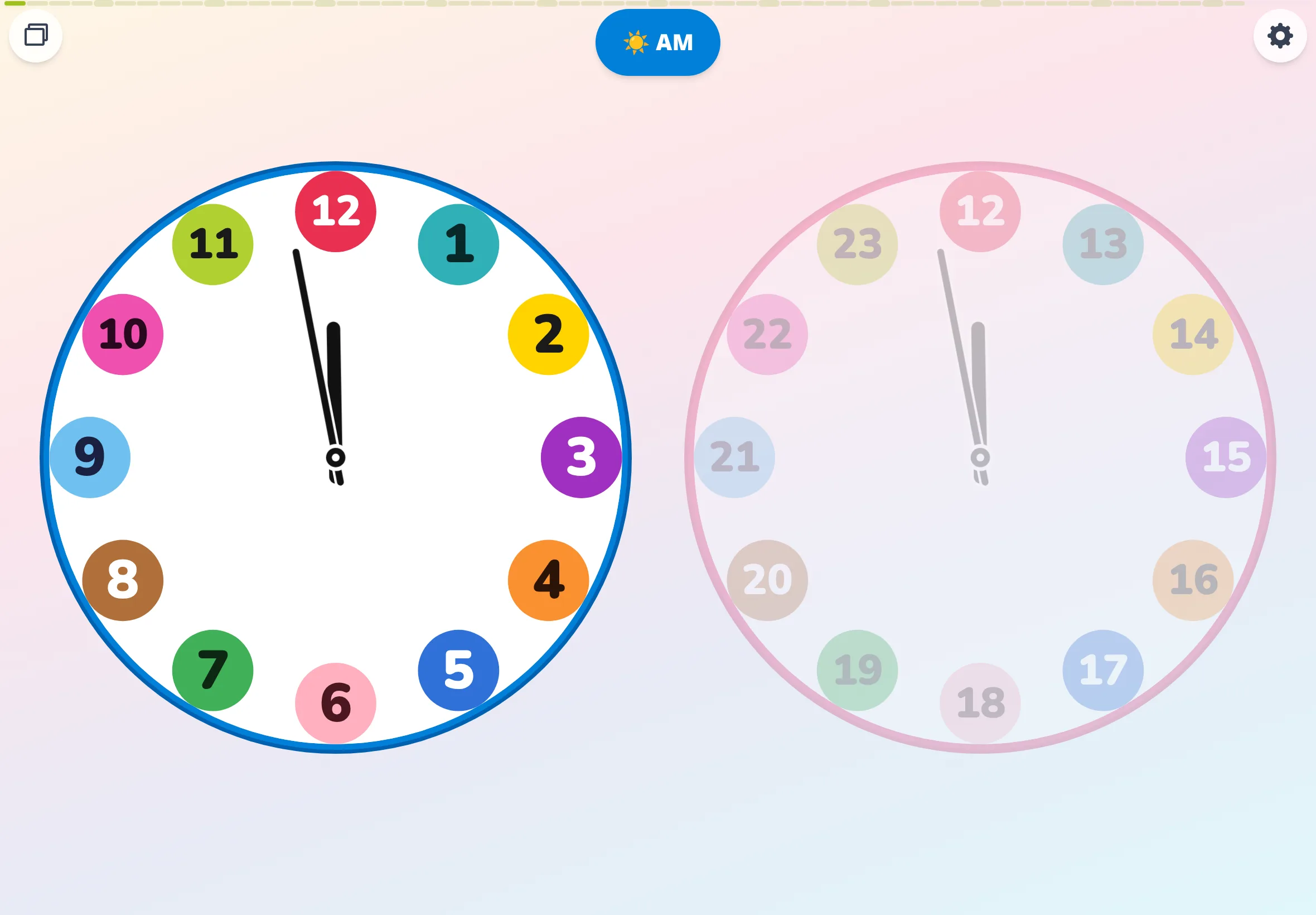
So instead of asking them to go around twice, lay the other 12 hours out next to the first. Inside Futatoki the Learning Clock App's free spin mode, there's a button called "stack / split." "stack" looks just like the regular clock at home; press "split," and the hidden half steps forward as a second face.
02

Lay them side by side, and 24 hours come into view.

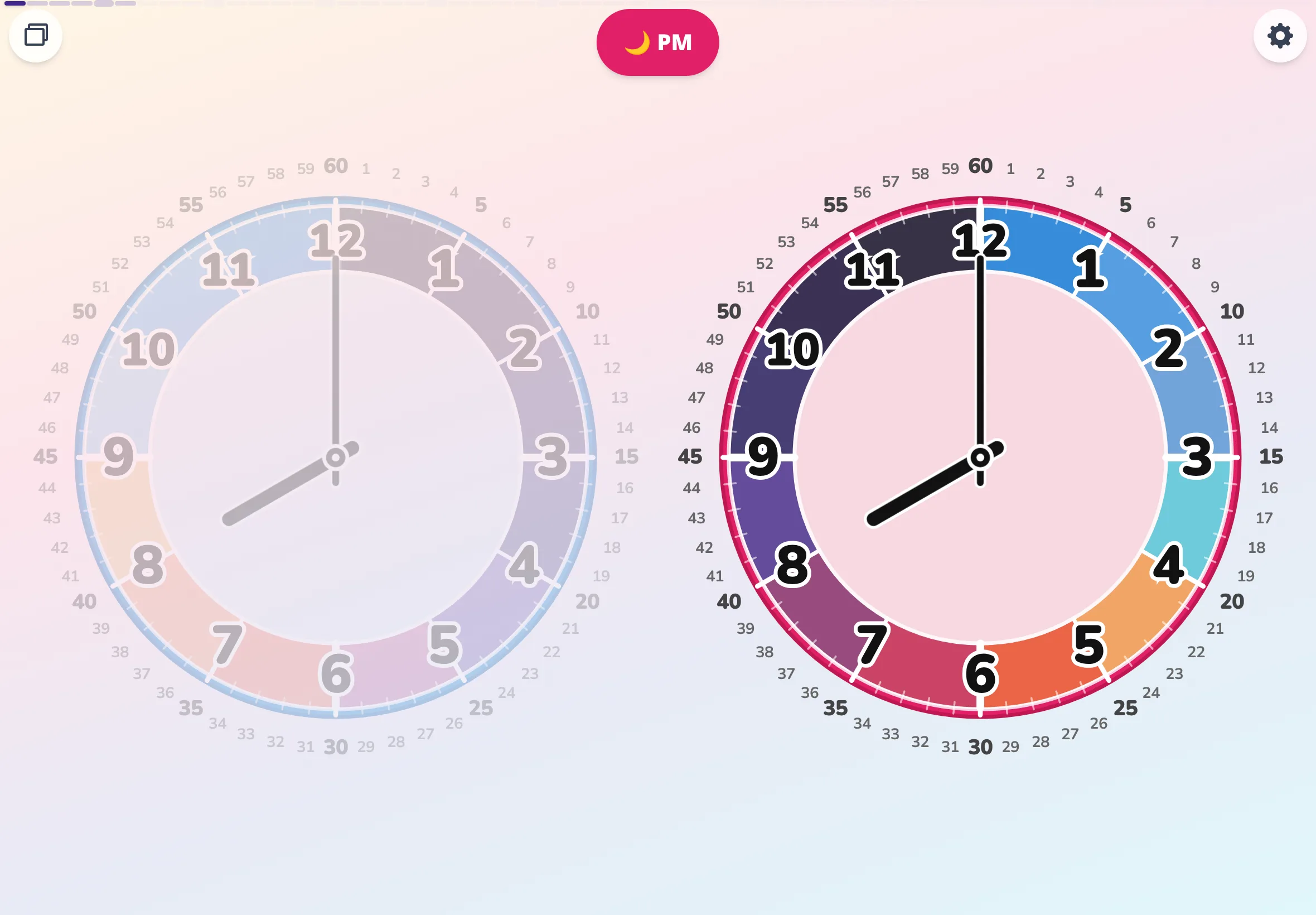
Tablet view of Futatoki the Learning Clock App with AM and PM faces placed next to each other — a kids' clock app that lines up two ordinary analog faces to make the morning/evening difference visible.
The hidden side steps forward as a second face.

Press "split," and the AM face and PM face appear next to each other. The AM face runs 1 through 12; the PM face runs 13 through 23. Eight in the morning sits on the AM face. Eight at night sits on the PM face. The same "8 o'clock" lives in two different places — a single day, drawn as two pictures.

A common mix-up: Futatoki the Learning Clock App is not a special grown-up clock that does one full lap in 24 hours. For a child who finds clocks a little tricky, it's just two perfectly ordinary 12-hour analog clocks, placed side by side. So it sits right alongside the familiar dial they already know — nothing to brace for.

03

I believe 24 hours actually reaches a child first.

A child just starting to learn numbers takes them in by order: 1, 2, 3, and onward. My guess is that what reaches them most naturally is when that climbing sense of numbers lines up exactly with the climbing flow of time — that's what I believe.

Wake up: 8. Lunch: 12. Snack: 15. Dinner: 18. Bed: 21. The order of numbers your child already knows is the order of the hours.

There's no need to suddenly switch to "let's read it in 24-hour time." With "stack," the clock looks like the everyday one at home. With "split," it's two faces side by side. Whichever lands more easily on your child's eye — your child gets to choose.

04

12 always sits at the top.

Futatoki the Learning Clock App on a tablet showing the 24-hour face with 12 fixed at the top — a kids' analog clock app that hides 0 and 24 and keeps only 12 as the anchor at the top of the dial.
12 alone never becomes 0 or 24.

On the 24-hour face, 0 and 24 never appear. Instead, 12 stays right at the top of the dial. Morning or night, the top of the face is always 12. The visual cue lines up exactly with an ordinary 12-hour clock.

With 12 at the top as the boundary, the AM face and the PM face physically split apart and sit side by side. The same "8 o'clock" lives in two places: morning 8 on the AM face, evening 8 written as 20 on the PM face. To your child's eye, "8 on the left" and "20 on the right" arrive as two different times, in two different places.

Saying out loud "evening 8 is 20 in 24-hour time" lands more slowly than pointing at the two faces together. "See — evening 8 is written as 20 on the PM face." Just looking at the two faces side by side, the match settles in on its own.

05

When your child asks why this clock isn't like the one at home.

Switch to the 24-hour face, and most children will ask: "what's 13?" "what's 14?" "why is it different from the clock at home?" The words you choose in reply — that's the most important part of how all this gets across.

The answer doesn't have to be complicated. Just one line: "the usual clock has AM and PM stacked on top of each other." Then, in Futatoki the Learning Clock App, press "stack / split" and let your child watch the stacked shape and the side-by-side shape flip back and forth.

"Oh — the usual clock was two clocks all along." The moment your child notices this on their own is when the length of 24 hours sinks in the deepest. Less explaining. More touching. Sit beside them, stack and split the clock together, and look at the two sides as one.

GUIDE

Growing how to read the clock together

From "getting used to it" through to "reading the clock down to the minute," eight steps with sample lines and setting changes for each.

Read the 8-step parent-and-child guide

Try opening it.

24 hours travels faster when you show it than when you explain it. Set two analog clocks side by side, gently undo the place where AM and PM stack — just laying them out, the shape of a day starts reaching your child's eye.

Futatoki the Learning Clock App opens right in any browser. No account, no install. No ads. In free spin mode, with "stack / split," sit with your child and let the two sides of the clock flip back and forth.

Back to home