🇺🇸
Open app

Put two side by side, and the rules come out.

After the author's daughter learned to read the clock, one question lingered: why so fast? This is the after-the-fact answer.

This app lays two clocks side by side to keep AM and PM out in the open. That was the design from the start, and it still is. But thinking back on how the author's daughter used it, it began to seem that the pair was doing one more job — one that only became clear in hindsight. This article is that reflection.

01

The answer came later.

Within about four days of starting Futatoki the Learning Clock App, the author's daughter — five at the time — could read an analog clock. She could already read digital clocks, but at preschool she'd been quietly down about being the one who couldn't read the analog kind. One case, N=1; there's no claim to generality here. Still, as the person who built the app, one question wouldn't go away: why so fast?

While building it, the reason for two dials seemed settled: to show AM and PM. A day contains eight o'clock twice — put that fact in front of the child. That was the starting point, and it hasn't changed.

But replaying where her eyes must have been, it started to seem that the pair itself was doing another kind of work. Maybe it was half-sensed at build time; the words only came later. What follows is that afterthought, written down.

02

One clock looks random.

To a child, an analog clock is a mysterious shape-shifting thing. It was one way when they looked before; it's another way now. Without seeing the motion in between, the change might as well be random.

Comparing "before" with "now" on a single clock runs on memory. You hold on to where the hands were, then overlay that on where they are — adults do this without noticing, and for a child it can still be hard. The thing being compared isn't in front of them; no wonder.

And as long as the clock reads as random, the numbers on the dial and the lengths of the hands stay a pile of unrelated things to memorize. Only once a rule comes into view do the parts start to mean something.

03

Two clocks show "always the same."

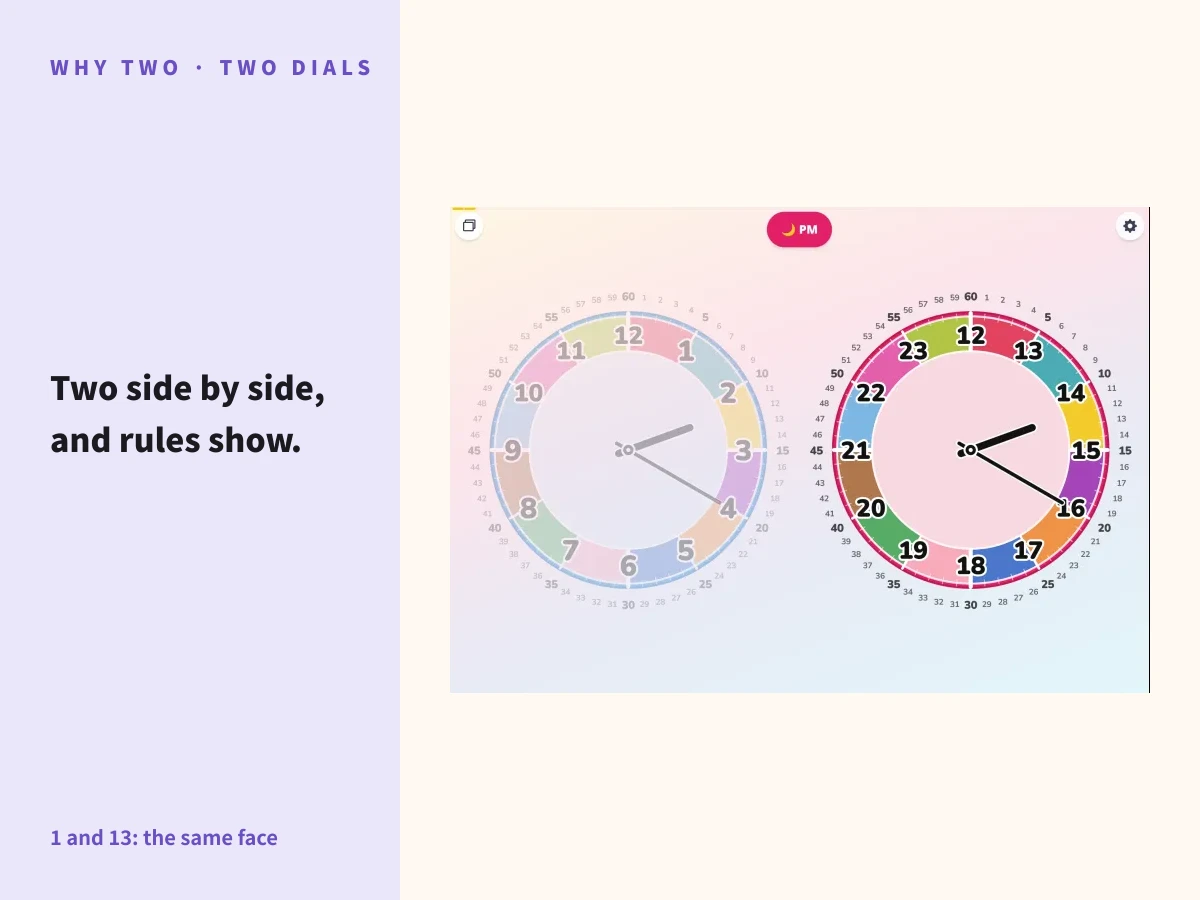
Put two clocks side by side, and the comparing happens right in front of you. Futatoki's AM dial and PM dial wear the same face at every moment — morning or evening, the hands sit in exactly the same place on both.

In the 24-hour display, the match takes an even better shape. The PM dial's numbers change to 13 through 23, yet the hands stay exactly where the AM dial's hands are. One o'clock and thirteen o'clock: different names, same face. The match survives the change of numbers.

Seen alone, the clock was "a thing that changes at random." Seen as a pair, it becomes "two things that always move exactly alike." "Hey — these two are always the same." At that moment, we suspect, the clock starts turning from a capricious object into a machine that follows rules.

04

Rules surface when examples stand in a row.

A rule is hard to find in a single example. One occurrence is indistinguishable from chance. It's when concrete cases line up — this one too, that one too — that the shared rule floats into view.

That's how words are learned, and numbers. Three apples, three oranges, three dumplings — line them up, compare them, and out comes "three," a thing that is none of the fruits. Until there's enough to compare, the rule keeps out of sight.

Putting two clocks side by side, then, builds the chance to compare into the clock itself — that's the current thinking. A child who can watch one clock long and patiently enough would get there too. Two clocks trade that long watch in time for a single look in space.

05

"Two" turned out to mean more than AM and PM.

So the answer to "why two?" now comes in two parts. The first hasn't changed since the design: to show AM and PM without hiding either. The second found its words later: with a partner to compare against, the clock's rules may be easier to notice.

The second part is still a hypothesis, reasoned backward from one child. Even so, it's a useful lens when imagining where a child's eyes go on the paired dials. Not teaching — just confirming together: "look, the same." That alone seems to carry something across.

  1. 01. Compare the two dials and find the hands in the same place on both
  2. 02. Run auto spin through a whole day and watch the two move in step the entire time
  3. 03. Use "stack" in free spin to fold the dials together and see them line up exactly

None of these are teaching moments. Saying "same!" to each other is plenty.

GUIDE

Growing how to read the clock together

The order and the sample lines that keep a noticing from turning into a lesson — collected in eight steps.

Read the 8-step parent-and-child guide

Watch the pair together.

The moment a clock turns from a random mystery into a thing that follows rules probably can't be seen from outside. One day you look back, and the reading has arrived — that's how it went with the author's daughter, too.

Futatoki opens in the browser. No account, nothing to install. Start by simply watching the two dials together, side by side, with your child.

Back to home